Call Us
Phone: (707) 347-3935
Tue - Sat: 8:00 AM - 9:00 PM
Sun - Mon: Closed

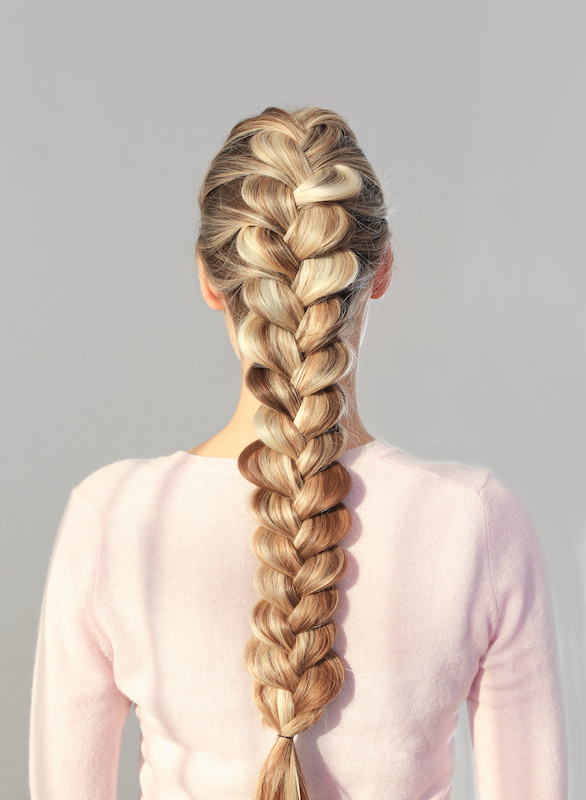
In the simplest form of three-strand braid, all the hair is initially divided into three sections, which are then simultaneously gathered together near the scalp. In contrast, a French braid starts with three small sections of hair near the crown of the head, which are then braided together toward the nape of the neck, gradually adding more hair to each section as it crosses in from the side into the center of the braid structure. The final result incorporates all of the hair into a smoothly woven pattern over the scalp.
If the main mass of hair is initially parted into two or more sections along the scalp that are kept separate from one another, multiple French braids may be created, each in its own section. One unique feature about the French braid is that an individual can braid their own hair without the help of others. (The difficulty of braiding can depend on the type of hair the individual has, however, as some styles of hair are easier to braid than others.) The length of hair also plays a role in the ability to braid; shorter hair can be more of a challenge. Bobby pins can be useful when braiding shorter hair or hair with many different layers to keep all of the hair in the French braid in place. There are many different ways of French braiding that make it unique; for example, a person can braid at a slant, braid into a bun, or only braid the bangs (fringe).
Compared to the simplest form of hair braid, a French braid has several practical advantages: it can restrain hair from the top of the head that is too short to reach the nape of the neck, and it spreads the weight and tension of the braid across a larger portion of the scalp. Its sleek appearance is often regarded as being elegant and sophisticated. A French braid is more difficult to construct than a simple braid because of its greater complexity. When performed on one's own hair, it also requires a more prolonged elevation of the hands above the back of the head, and leaves more tangled hair along the scalp when unbraiding.
In this style of braid, start on top of the head and braid it till the end of the hair. Braiding in this manner can be done with different braid types but the most popular are the classic braid and the fishtail braid. A sister braid to the French braid is the Spanish braid. The Spanish braid is like a French braid but in the beginning, instead of grabbing three sections of hair, only two are used.
Read more, here.

Olaplex is product for damaged hair developed by two chemists, Eric Presley and Craig Hawker, which is advertised as rebuilding broken bonds in hair caused by chemical, thermal, and mechanical damage. The active ingredient of Olaplex is a chemical compound called bis-aminopropyl diglycol dimaleate.
All Olaplex products contain a patented ingredient called bis-aminopropyl diglycol dimaleate, with the aim of rebuilding broken hair disulfide bonds. Hair's protein, keratin, contains the amino acid cysteine and cysteine contains sulfur atoms; Normally, two sulfurs form a disulfide bond and bind between two proteins, which preserves the shape and texture of the hair, and straightening, curling, and hair dye break the bonds and turn them into free thiol. The second product is set to complete the hair restoration and the third is used by the consumer with the intention of final protection of the hair.
Read more, here.

Wella AG is a German hair care company headquartered in Geneva, Switzerland. Founded in 1880 by Franz Ströher, it specialises in hair care, styling and colorants sold to individuals as well as hairdressers and was controlled by Procter & Gamble from 2003 until it was sold to Coty Inc. in 2015 along with some 40 other P&G brands. On December 1, 2020, Coty completed the sale of the Wella, Clairol, OPI and ghd brands stake to American private equity firm KKR for $2.5bn in cash whilst retaining 40% stake in the standalone company.
On October 1, 2021, Coty announced that it would sell an approximate 9% stake to KKR for $426.5 million. The deal reduces Coty's stake in the Wella, Clairol, OPI and ghd brands to around 30.6%.
On November 8, 2021, Coty agreed to sell an approximate 4.7% stake in Wella to KKR in exchange for the redemption of approximately 56% of KKR's remaining convertible preferred shares in Coty. The deal reduces Coty's stake in Wella, Clairol, OPI and ghd to approximately 25.9%. KKR will continue to have a 2.4% ownership stake in Coty on an as-converted basis.
Read more, here.
